
Maritime – Electrification and System Integration
Electrification is also gaining ground at sea. This is especially true when duty cycles are predictable. We help manufacturers and operators of ferries, workboats, and special-purpose vessels implement electric systems as functional turnkey solutions.

Practical Requirements
Challenges
Decarbonization under regulatory pressure
Shipping accounts for up to 3% of global greenhouse gas emissions. Regulatory initiatives such as FuelEU Maritime aim to reduce emission intensity by up to 80% by 2050. Consequently, the pressure to implement concrete solutions is increasing.
No single technological silver bullet
Studies clearly show that, unlike in other segments, there is no single technology that meets all the requirements of the shipping industry. While e-fuels and hydrogen are being discussed for ocean-going vessels, electrification is primarily gaining traction where duty cycles are limited and predictable.
Energy requirements and system limits
Battery-electric systems are efficient, although the energy density of batteries imposes limits. Range, weight, and installation space restrict their use in large ships, whereas these systems are economically and technically viable for ferries, inland waterway vessels, and workboats.
Infrastructure and charging capability
Electric vessels require high-performance charging infrastructure. Short port stays necessitate coordinated fast-charging systems, such as Megawatt Charging, which must be integrated into existing and new grid structures.
System integration as a central challenge
Drive, battery, power distribution, charging connection, safety systems, and control must function as a complete system. This is precisely where the greatest complexity lies – and the key success factor.
Are these your challenges as well? We would be happy to develop the right solution for you.
Turning Complexity into a System
Electrification for predictable operations on the water
Electrification in the maritime sector follows a clear pattern: it has the greatest potential where operations are predictable, energy requirements are calculable, and charging infrastructure can be established. Ferry, workboat, and special-purpose vessel projects already demonstrate today that electric systems are economically and technically viable.
For these applications, we develop integrated turnkey systems – from system architecture to implementation. In doing so, we do not focus on individual components, but on the interplay of high-voltage architecture, battery integration, charging infrastructure, thermal management, and control software.
A central lever lies in systemic thinking. Electrification is more than just replacing a diesel engine. It changes energy flows, operating strategies, and the entire architecture of the system. This is precisely where efficiency gains, new operating models, and economic advantages arise.
5 Reasons for SUNCAR
Why SUNCAR for maritime applications?
Whether on land or at sea: with SUNCAR, you can count on an experienced partner that focuses on practical, comprehensive solutions.
Focus on feasible applications
We focus on segments where electrification has proven itself: ferries, inland waterway vessels, and workboats, as well as special applications with predictable duty cycles.
System integration instead of isolated solutions
Maritime electrification brings systemic challenges. We combine drive, battery, power distribution, charging, and software into functional turnkey solutions.
Transferable off-highway experience
Our experience from construction machinery, municipal vehicles, and other off-highway applications can be selectively transferred to maritime systems – particularly regarding robustness and integration.
Technology, products, and implementation from a single source
We provide not only development but also our own components and support projects through to validated application in real-world operation.
Convinced? Then please get in touch with us. We look forward to supporting you with your project.
Tailor-made Solutions
Relevant Products and Technologies
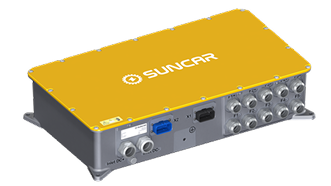
High-voltage distribution systems
The central interface for power distribution at sea. Our HV systems connect the battery, power electronics, and consumers safely and robustly.
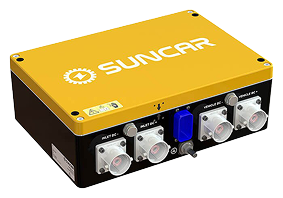
DC Fast Charging Interfaces
Charging capability is crucial for the operation of electric vessels. Our DC charging interfaces enable fast charging cycles and are compatible with commercially available port infrastructure and standards.
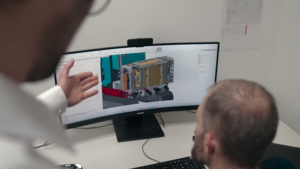
Thermal management
Batteries and power electronics must function reliably even under continuous load. Thermal stability is critical for safety, service life, and performance at sea.

Control software and energy management
Electric vessels require coordinated control of the drive, energy flows, charging processes, and safety systems. We develop the corresponding system logic and integration.

Monitoring & operating data (INSIGHT)
Operating data provides the basis for continuous optimization. Load profiles, energy consumption, and charging behavior are transparently logged and visualized.
Our Approach
Our Process
Structured development processes are the foundation of successful electric vehicle and system developments. We accompany OEMs, machine manufacturers, and industrial companies from the initial concept idea to series integration.

Analyze Application Profile
We analyze routes, load profiles, operating times, and charging windows.
Define System Architecture
We develop the architecture for the battery, drive, HV systems, charging integration, and control.
Implement Integration
All components are integrated mechanically, electrically, and via software.
Validate and Optimize
The system is tested in real-world operation and further developed based on operating data.
SHALL WE GET STARTED?
Electric maritime systems for real-world duty cycles
Talk to us about system architecture, integration, and the implementation of your electric solution in the maritime environment.