
Construction Machinery – Electrification and System Integration
Construction sites are changing: Cities, public clients, and operators are demanding lower emissions, less noise, and more efficient machines. We support OEMs and operators in implementing electric construction machinery as functioning complete systems.

Practical Requirements
Challenges
Regulatory Pressure on Construction Sites
Zero-emission construction sites are no longer a future topic. Cities such as Oslo have already introduced clear requirements and are using public tenders to drive zero-emission machines and construction sites forward.
Emissions, Noise, and Indoor Use
Construction machinery generates local emissions and noise. Electric machines significantly reduce these impacts and enable new applications, such as in tunnels or other enclosed areas where diesel machines can only be used to a limited extent.
Energy Demand and Charging Capability
Electrification rarely fails due to the concept, but rather due to the design: Battery size, charging times, fast charging, load profiles, and the required infrastructure must match the real application.
Complex System Integration
Construction machinery is not road vehicles. Work functions, hydraulics, drive systems, thermal management, and software are more tightly interconnected. That is precisely why a simple retrofit is often not sufficient.
Installation Space Is Limited
All-day operational readiness is a central requirement for many machine types. This requires corresponding battery capacities. Here, installation space often represents the actual limitation – not weight.
Are these your challenges as well? We would be happy to develop the right solution for you.
From Complexity to System
Construction: Our Solution Competence
Studies show a clear picture: Electrification takes hold first where usage profiles, charging infrastructure, and economic benefits align. Compact machines, urban applications, indoor use, and applications with predictable operating cycles offer immediate potential. While initial applications emerged with compact machines, the focus is increasingly shifting to more power-intensive machines where electrification can realize significant economic advantages. Depending on the usage profile, hybrid architectures are also a central component of sustainability efforts.
We do not just develop electric subsystems, but consider the machine as a complete system. This includes high-voltage and low-voltage architecture, battery integration, charging interfaces, thermal management, control software, and the integration of existing work functions.
An important lever lies in rethinking existing machine architectures. Particularly in the hydraulics area, electrification can be more than a drive change: It opens up the possibility to question old paradigms, rethink energy flows, and systematically improve system efficiency.
5 Reasons for SUNCAR
Why SUNCAR for Construction
Because SUNCAR is one of the few development partners that masters the entire development process, from system architecture to validated machine, from its own experience.
Experience with Real Electric Excavator Projects
We have already developed, built, tested, and further developed numerous construction machines. This experience is central because challenges only become fully visible in real-world use.
System Thinking Instead of Retrofit Logic
The market is moving away from simple conversions toward integrated electric machines. We think holistically about drive, battery, thermodynamics, software, and work functions.
Relevance for Urban and Regulated Construction Sites
Less noise, no local pollutant emissions, and new requirements in public tenders make electric construction machinery competitively relevant.
Efficiency Through New Architecture
Electrification makes it possible to reevaluate existing hydraulic and drive concepts. This is precisely where SUNCAR can help, not only to become emission-free, but also more efficient and to question existing machine architectures.
Faster from Concept to Validated Machine
We shorten development cycles by drawing on proven components, architectures, and project experience. This reduces time-to-market – with reduced development risk and a clear perspective on series implementation.
Convinced? Then please get in touch with us. We look forward to supporting you with your project.
Success Stories
Reference Projects
Successful electrification projects from various industries
Tailor-made Solutions
Relevant Products and Technologies for Electric Construction Machinery
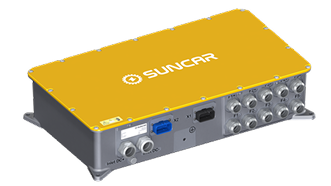
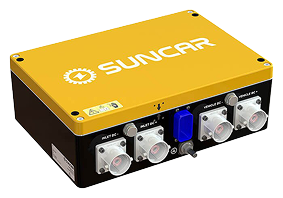
High-voltage distribution systems
Electric construction machinery requires safe and robust HV architectures for distribution, protection, and integration of power components.
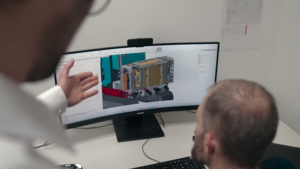
Control Software and System Logic
Electric construction machinery requires coordinated control of drive systems, work and assistance functions, charging processes, and safety functions.

INSIGHT Monitoring
Operating data helps, thanks to monitoring systems, to understand real load profiles, analyze charging behavior, and further develop products based on field experience.
Our Approach
Our Process

Analyze Application Profile
We analyze the machine, load profile, deployment location, operating duration, and charging windows.
Define System Architecture
We develop the architecture for battery, drive, HV/LV systems, thermodynamics, software, and charging.
Implement Integration
The subsystems are mechanically, electrically, and software-integrated into the machine.
Validate and Optimize
The machine is commissioned, tested, and further developed based on real operating data.